How Does a Backrest Adjustment Mechanism Work? Two Positions and Scissor Arms
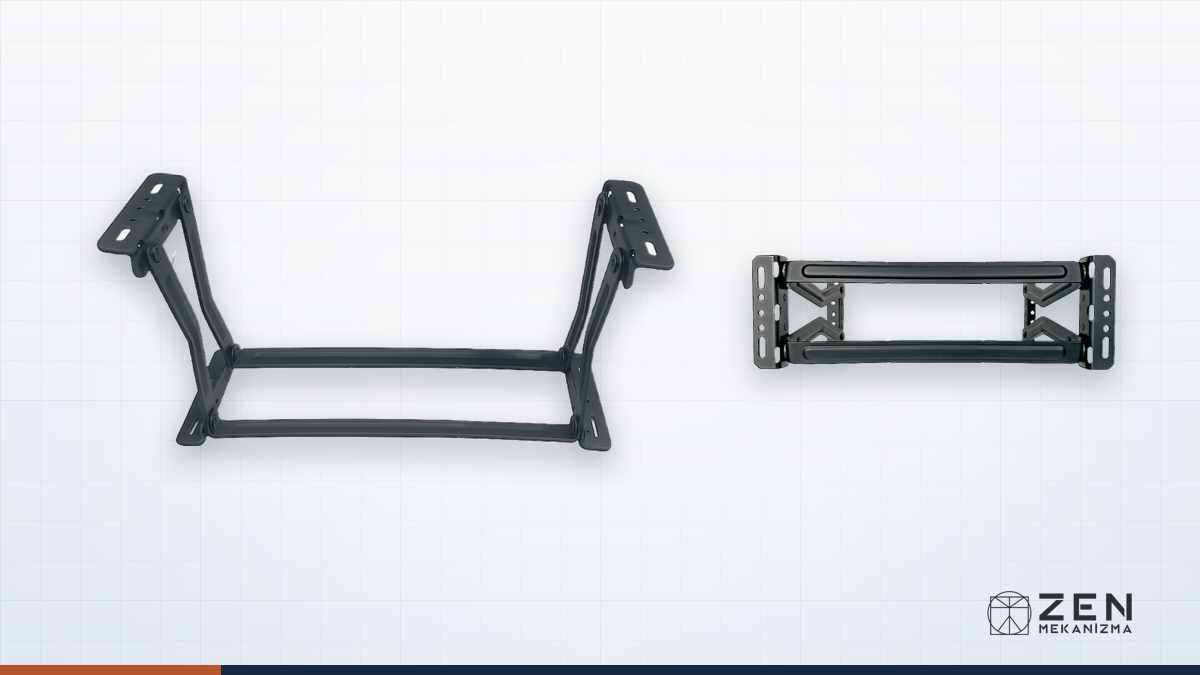
A backrest adjustment mechanism moves the back section of sofas and armchairs forward and backward to change the seat depth. Pulled forward, the back gives the sitting position; pushed back, it gives the relaxing position, which deepens the seat. In the trade it is also known as a back pull mechanism.
The parts that carry the movement
The mechanism is made of three main parts:
- Scissor arms. On each side a pair of arms connects the back to the frame. As the arms turn on their pivots, the back moves forward or backward.
- Two steel tubes. They join the left and right units, so the set arrives as a single welded unit rather than two separate parts. The word "tubular" in the catalogue refers to this construction.
- Mounting plates. The set bolts to the frame at four points, so the load is not concentrated on a single line of screws.
Two positions: sitting and relaxing
The mechanism has two end positions, and the back rests in one of them:
- Sitting position: the back is pulled forward by hand. The seat is shallower — for everyday sitting.
- Relaxing position: the back is pushed back by hand. The seat gets deeper — for long sessions and lounging.
There are no intermediate steps or locks, and no separate lever or button. How far the back travels is listed in the technical table on the product page.
The same sofa does two jobs: the back comes forward when you sit with guests and goes back when you watch a film. The whole job of a backrest adjustment mechanism is the change between these two positions.
What to watch during upholstery and assembly
Because the mechanism sits under the upholstery, upholstery and assembly are the critical stages:
- Keep the path behind the back clear. In the relaxing position the back moves rearward; if the frame, foam or fabric narrows that path, the back will not settle fully into position.
- Do not pack material between the scissor arms. Foam and fabric caught in the arms' range of movement make it stiffer and wear over time.
- Use all four fixing points. Skipping screw holes raises the load on the remaining ones. See common assembly mistakes for detail.
How many sets does a sofa need?
There is no fixed number. The quantity is set per project according to the width of the back: send us the back dimensions and we will work out the number of sets with you. The standard set is produced in 220 and 260 mm sizes with L22 and L26 tubing; other sizes are assessed per project.
Where it is used
- Sofas: switches between the sitting and relaxing positions.
- Armchairs: offers two seat depths within the same frame.
- TV and lounge chairs: for long sessions the back is pushed back for a deeper seat.
Does it need maintenance?
No routine maintenance programme is required. Check the pivots and fixing screws from time to time, depending on how heavily the furniture is used, and if squeaking starts, apply light machine oil or a silicone-based spray to the pivots. See maintenance and lifespan of seat mechanisms for detail.
If you are evaluating a backrest adjustment mechanism for your project, send your back dimensions and quantity through the contact page and we will work out the right solution with you. For an overview of the other mechanism types, types of sofa mechanisms is a good starting point.
Frequently Asked Questions
How does a backrest adjustment mechanism work?
Scissor arms on each side connect the back to the frame. Pulled forward by hand, the back moves to the sitting position; pushed back, it moves to the relaxing position, where the seat is deeper. No separate lever or button is needed.
How many positions does a backrest adjustment mechanism have?
Two: sitting and relaxing. The mechanism rests in one of these two end positions; there are no intermediate steps.
Is the mechanism visible from outside?
No. It is fitted to the frame and stays under the upholstery, so once upholstery is complete it is hidden and the outline of the furniture does not change.
How many backrest adjustment sets does a sofa need?
There is no fixed number; the quantity is set per project according to the width of the back. Send us the back dimensions and we will work out the quantity with you.
Does it need maintenance?
No routine maintenance programme is required. Check the pivots and fixing screws from time to time, depending on how heavily the furniture is used, and apply a suitable lubricant to the pivots if squeaking starts.
Let's find the right mechanism for your project together
Browse our products or get in touch with us.