Sizing a Rotating Table Mechanism: Working Out Dimensions and Load
The first question asked about a rotating table mechanism is usually "how much can it carry?". The better question has two parts: how heavy is the top, and where does that weight land? The load a mechanism carries at its centre and the load it meets when someone presses on the edge are not the same thing. This guide walks through the sizing decision in order.
Verified data first: standard size and build
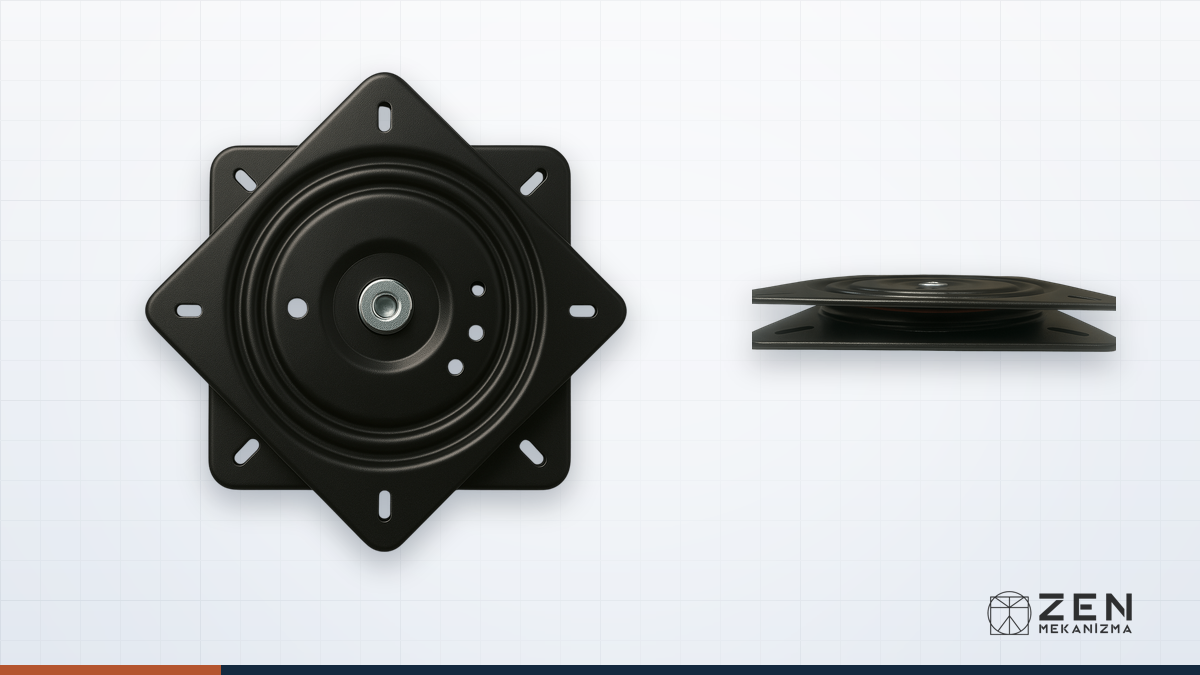
The Zen Mekanizma swivel mechanism has a standard size of 26 × 26 cm. The body is steel; the surface is protected with galvanised or chrome coating and can be strengthened with electrostatic powder coating. Custom sizes are available.
You will not find a single load figure here, and that is deliberate. Capacity varies with the size of the plate, the ball race used and the way the mechanism is mounted; a range quoted without those conditions does not simplify the choice, it misleads. So the steps below are not there to help you guess a capacity — they are there to work out what you need to send us.
Step 1: Calculate the weight of the top itself
Multiplying material density by volume gets you very close to the real figure. Practical values for the three most common materials:
| Material | Approx. density | Weight at Ø 90 cm, 2 cm thick |
|---|---|---|
| Marble / natural stone | ~2.7 g/cm³ | ≈ 34 kg |
| Glass | ~2.5 g/cm³ | ≈ 32 kg |
| MDF / chipboard | ~0.7 g/cm³ | ≈ 9 kg |
The arithmetic is simple: radius² × π × thickness × density. For a marble top 90 cm across and 2 cm thick, 45² × 3.14 × 2 gives about 12,700 cm³, which at 2.7 g/cm³ comes to roughly 34 kg. The same top in MDF is around 9 kg — more than a fourfold difference, and it is that difference which drives the choice of mechanism.
Step 2: Add what goes on top
The top's own weight is only half the sum. Plates and pots on a serving table, the goods on display in a cabinet, the device itself on a TV platform all add to it. In practice users also lean on the surface from time to time: an extra 20–30 kg, however briefly, is not unusual.
Step 3: Think about edge load separately
This is the most commonly skipped step. When load lands at the centre, the mechanism simply carries it. When it lands at the edge, a lever forms: the top is pushed down on one side and lifted on the other. That is the force trying to pull the two plates apart.
The way to weaken that lever is to widen the mounting footprint. Which is why heavy, wide tops need not only a higher-capacity mechanism but a physically larger one.
Tipping usually comes not from exceeding a capacity but from the load landing in the wrong place. That is why size is decided before capacity.
Step 4: Check size against top diameter
A common starting ratio in the industry: the edge length of the mechanism should be roughly one third of the diameter of the top. On a Ø 75–80 cm top, the standard 26 × 26 cm sits right on that ratio. As the top grows, or as edge loading becomes more likely, the size goes up.
This is a starting point rather than a rule. For a firm decision, send us the use case — the diameter, the material, the load going on top, and how likely edge pressure is — and we will settle the size together.
Assembly: what are the slotted holes for?
The screw holes at the corners are slotted rather than round, for a practical reason: if the holes drilled in the furniture end up a few millimetres out, the plate still seats properly and nothing needs re-drilling. In series production that saves real time on the line.
Other points to watch during assembly:
- Centring. The centre of the mechanism should coincide with the centre of the top; an off-centre fit gives a wobbling feel in rotation.
- Flat surface. A sloped or rough surface stops the plates sitting parallel and stiffens the rotation.
- Use every hole. Each hole left empty raises the load on the remaining ones.
Choose the coating for the environment
Galvanising gives sufficient protection for dry indoor use. In humid environments, or where the mechanism stays visible, chrome plating or an electrostatic powder-coated surface is preferred. Coating adds nothing to load capacity; its job is to protect the surface and extend life. See mechanism material and coating for detail.
Checklist
- Write down the material, diameter and thickness of the top.
- Calculate its weight (radius² × π × thickness × density).
- Add the load going on top and any likely leaning.
- If edge loading is likely, step the size up.
- If the environment is humid, pick the coating accordingly.
Send us those five items through the contact page and we can settle size and capacity in a single exchange. For the wider selection criteria, see how to choose a rotating table mechanism.
Frequently Asked Questions
How much load does a rotating table mechanism carry?
Capacity varies with the size of the plate and the ball race used, and it rises as the size increases. Rather than quoting a single published figure we prefer to learn the load in your project: send us your plate dimensions and the weight going on top, and we will determine the right size with you.
How do I calculate the weight of a marble top?
Multiply the square of the radius by π, then by thickness and density. Marble is about 2.7 g/cm³, so a top 90 cm across and 2 cm thick comes to roughly 34 kg.
How do I match mechanism size to top diameter?
A common starting ratio is for the edge length of the mechanism to be about one third of the diameter of the top. On a Ø 75–80 cm top the standard 26 × 26 cm fits that ratio. Larger tops, or a higher chance of edge loading, call for a bigger size.
Why is edge load harder on the mechanism than centre load?
Load at the edge creates a lever that tries to pull the two plates apart. The same weight is carried directly at the centre but produces a tipping effect at the edge, which is why wide tops call for a wider mounting footprint.
Are custom sizes available?
Yes. The standard is 26 × 26 cm, and other dimensions can be manufactured to project requirements. Just send the size of the top and the load it will carry.
Let's find the right mechanism for your project together
Browse our products or get in touch with us.